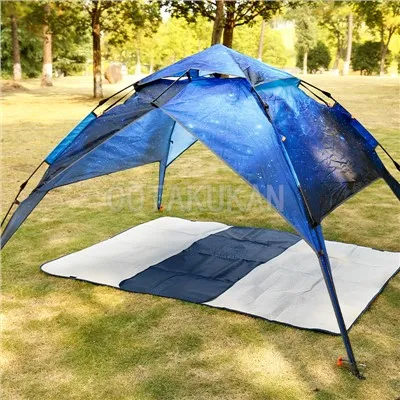
Tent structure
Jan 24, 2023
Depending on the purpose of use in the camp, tents can be divided into service, activity, sanitation, cooking, storage, accommodation, rest and so on. Various forms of tents have different structures and suitable places. This paper takes the traditional house-type account as an example to explain the names of its parts:
(1) House account
1. Tent roof: It is the slope of the upper part of the tent. Its main function is to shade, prevent wind and drain water.
2. Camp wall: It is the vertical part on both sides of the tent, so that the tent roof will not fall to the ground and affect the space inside the tent (but there is no cone tent, drapery tent, wing tent, exploration tent, etc.). Some tents have very large camp walls, such as overhead umbrella tent, beach tent, villa tent, etc.
3. Camp door: the camp door is opened at the front and rear ends, and only the front end of the fold for less than four people, while the rear end is closed as the camp wall, and screen windows are set on the wall to facilitate ventilation.
4. Floor cloth: it must be completely impermeable (such as PE cloth) to prevent the rise of underground moisture and sew it with the camp wall (it is better to fold it up by more than 10 cm, and the waterproof effect is better).
5. Screen door: open the camp door in the daytime, and only close the screen door to make the tent ventilated well and prevent mosquitoes and snakes from entering.
(2) Attachment of single-storey house account:
1. Battalion columns: Battalion columns are mostly jointed aluminum tubes, aluminum alloy tubes or glass fiber columns and glass fiber tubes used in yurts, while large tents are made of various steel pipes with strong bearing capacity.
2. Camp nail: It can be made of wood, metal or ABS plastic. In form, it can be divided into two types: linear type and sheet type. The length is about 20 cm. The linear type is easy to insert into the soil, but the bearing force is small. Therefore, it is generally used under the corner of the camp wall. The sheet type bears a large bearing force, and is used to fix the main and side camp ropes.
3. Main camp rope: It is used to fix the camp column, with a strength of more than 120 kg, at the front and rear ends of the tent.
4. Auxiliary rope: at the four corners of the tent, it is used to support the tent roof.
5. Auxiliary rope: at both ends (sides) of the tent, it can be used to support the camp walls on both sides to enhance the wind resistance.
6. Camp ropes: used to tighten various camp ropes, which can be divided into two types: closed type and open type, and can be made of wood chips, metal chips or plastic chips.
7. Camp hammer: There are two kinds of wood and plastic, only metal products are not used, which is easy to damage the camp nail.
8. Camp bag, camp nail bag, and camp column bag.